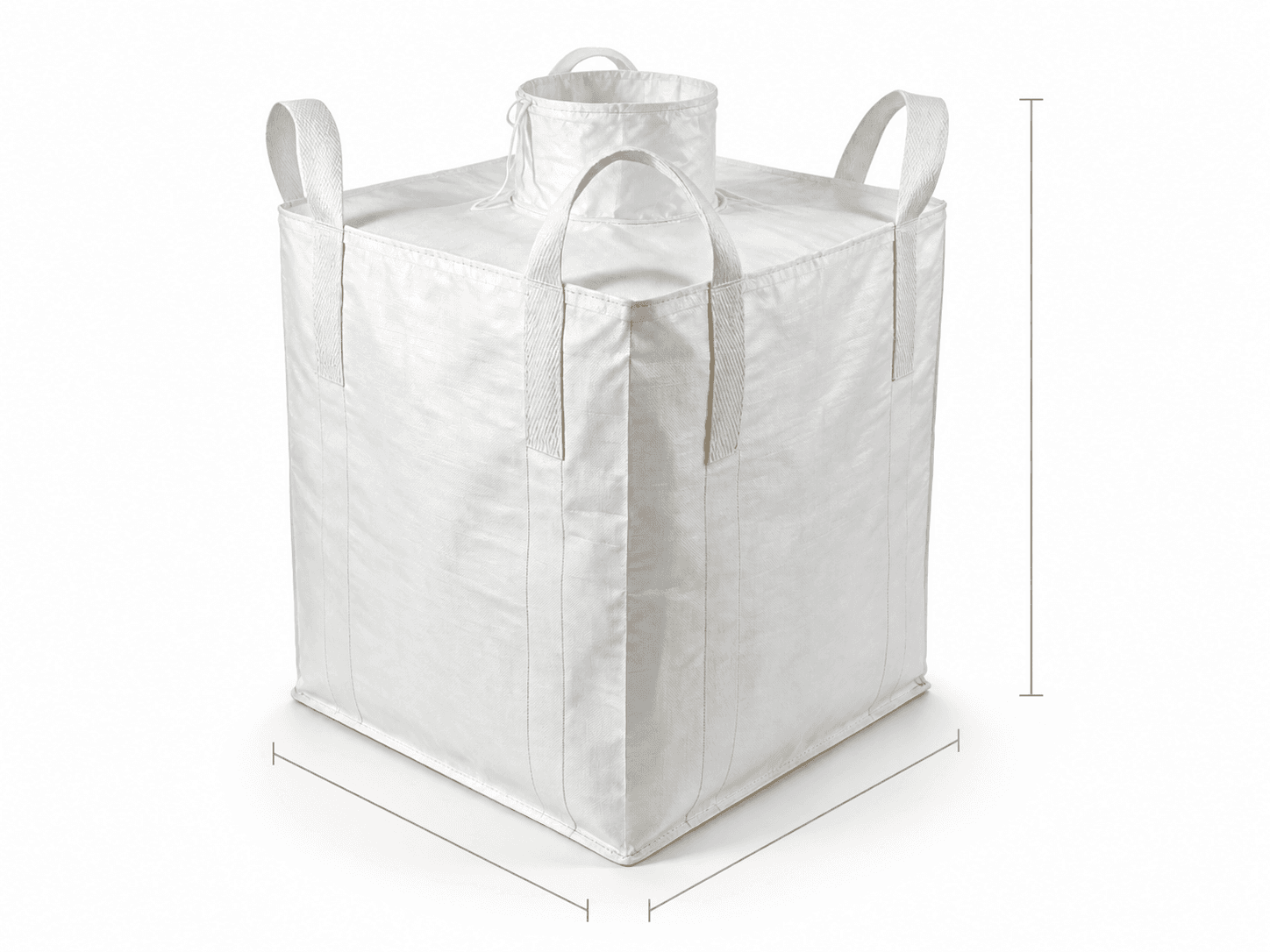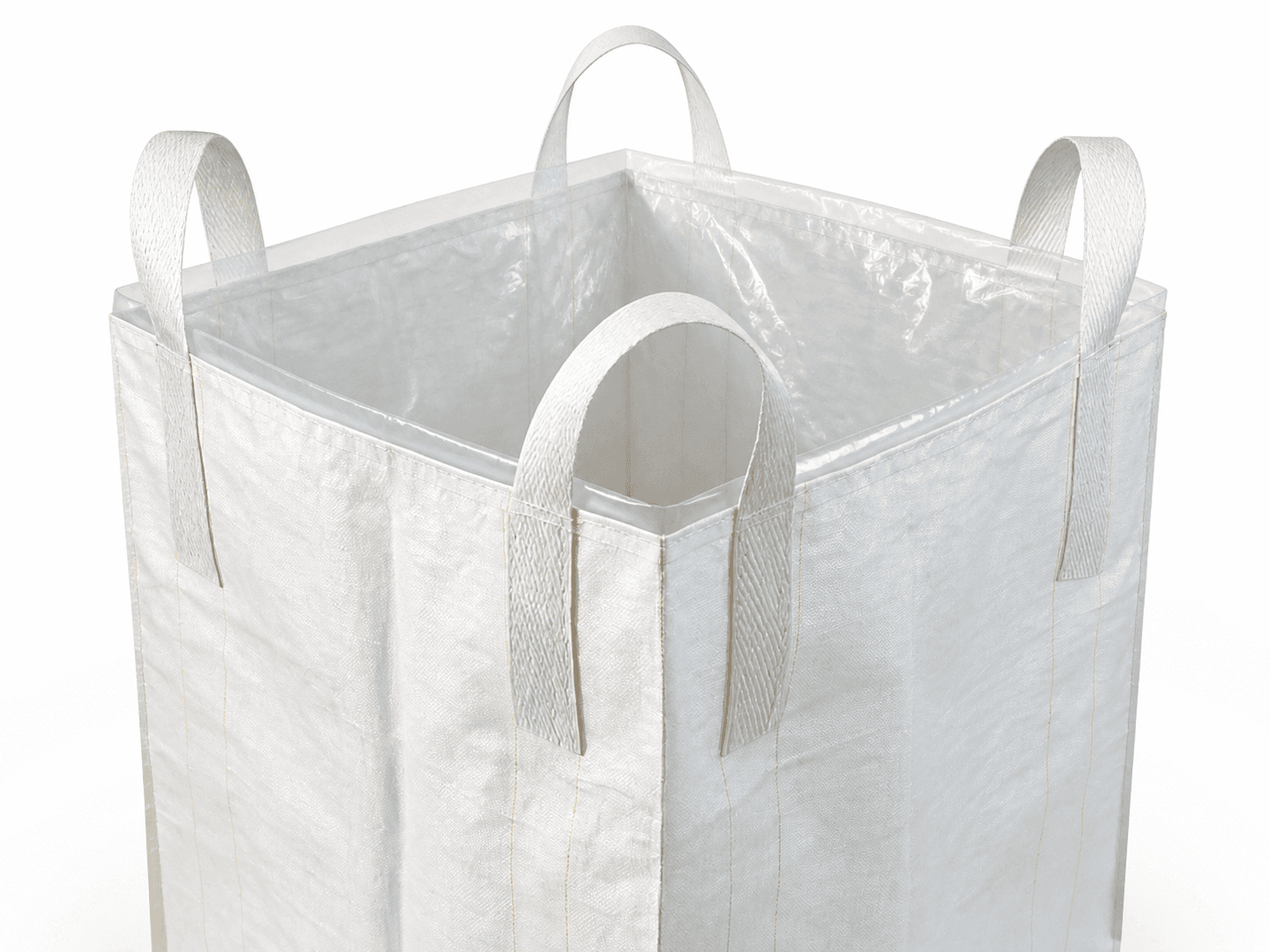
The bottom of a FIBC decides how the bag is emptied — and for many operations, emptying is where the real cost and time are spent. The two most common designs are the flat bottom and the discharge spout, and the choice between them depends on your process, not on which one looks more modern.
This guide compares flat bottom and discharge spout FIBCs across the factors that matter in practice: how the bag is emptied, how efficiently the product discharges, how often the bag is reused, and how the material itself behaves.
Why the bottom matters
Every filled bag has to come out again. The bottom of the bag determines whether that happens by cutting the bag open, tipping it, or releasing it through a controlled opening.
The right choice affects three things you can measure:
- Time per emptying cycle — how long each bag takes to empty.
- Residual product — how much material is left in the bag afterwards.
- Reusability — whether the bag survives emptying intact.
None of these are free. A bottom that empties faster may cost more or complicate closing. A simple flat bottom may leave more residue for certain products. The decision is a trade-off tailored to your material and your process.
Flat bottom
A flat bottom FIBC has a plain, continuous bottom panel. The bag is emptied by cutting the bottom open, tipping the bag, or discharging the material manually.
The flat bottom is the simpler of the two designs:
- Lower cost — a simpler construction than a spout.
- Strong and even base — good for stacking and stable standing.
- Flexible emptying — can be cut, tipped or emptied by hand, depending on the situation.
- One-way friendly — well suited to single-use or low-reuse cycles where the bag is cut open.
Its main limitation is control. There is no designed opening, so emptying tends to be a manual or one-time event. For a product that empties easily and a process that can tolerate cutting the bag, a flat bottom is often the most economical choice.
Discharge spout
A discharge spout FIBC has a cylindrical opening at the bottom, normally tied closed when the bag is filled and untied to empty it. The material flows out through the spout into a hopper, screw conveyor or other receiving point.
The discharge spout brings control to emptying:
- Controlled discharge — the material flows through a designed opening at a rate you can manage.
- Repeatable emptying — the bag can be emptied, closed and reused without cutting it open.
- Cleaner integration — connects directly to downstream equipment.
The trade-offs are a more complex construction and the need to handle the spout correctly: tying it securely after filling and opening it properly at discharge.
Discharge efficiency and residual material
How completely a bag empties depends on several things working together — the design of the bottom is only part of the story.
The flow behaviour of the product is usually the dominant factor. A free-flowing material such as cement or granular product discharges readily through a spout, leaving little residue. A cohesive or bridging material may need assistance regardless of the bottom type, whether it is flat or spouted.
Bag design also plays a part. The angle and shape of the bottom, the position and diameter of the spout, and whether the bag is lifted or allowed to settle all influence how much material remains.
The practical takeaway: if you need consistent, near-complete discharge for a free-flowing product, a discharge spout is the natural choice. If residual material is acceptable and the process empties the bag by cutting or tipping, a flat bottom does the job more simply.
Re-use and emptying frequency
How often a bag is emptied is one of the most direct signals for the bottom type:
- Single-use or occasional emptying — cutting a flat bottom open is fast and acceptable. A discharge spout is an unnecessary cost.
- Frequent, repeatable emptying — a discharge spout preserves the bag and speeds up each cycle, making it worth the extra complexity.
If a bag is expected to survive multiple trips — filled, emptied, closed and filled again — the spout is what makes that possible without damaging the bag. Products handled this way, such as materials shipped in reusable logistics, are where discharge spouts are most clearly justified.
Material handling considerations
The bottom type also interacts with how the material is handled downstream:
- Where the emptied product feeds a process directly, a discharge spout allows the bag to act as a small storage-and-release point.
- For products that are dusty, the controlled opening of a spout reduces dust at discharge compared with cutting a bag open.
- For materials that bridge or hold shape, a flat bottom that can be opened fully may actually empty more reliably than a narrow spout.
In other words, the discharge spout is not automatically "better" — it is better for specific conditions, and a flat bottom is better for others. Our cement application and manganese ore application show two different emptying contexts in practice.
Choosing for your process
To choose between a flat bottom and a discharge spout, start with three questions:
- How is the bag emptied today — and how do you want it emptied?
- Is the bag reused, or is it a one-way package?
- How does the material flow — freely, or with difficulty?
The answers will usually point to one design. Compare an open-top flat-bottom FIBC with an open-top discharge-spout FIBC, then confirm the choice around your product and process when the specification is discussed.